
Nollaig na mBan: Honouring the Women Who Shaped Ireland’s Equestrian World
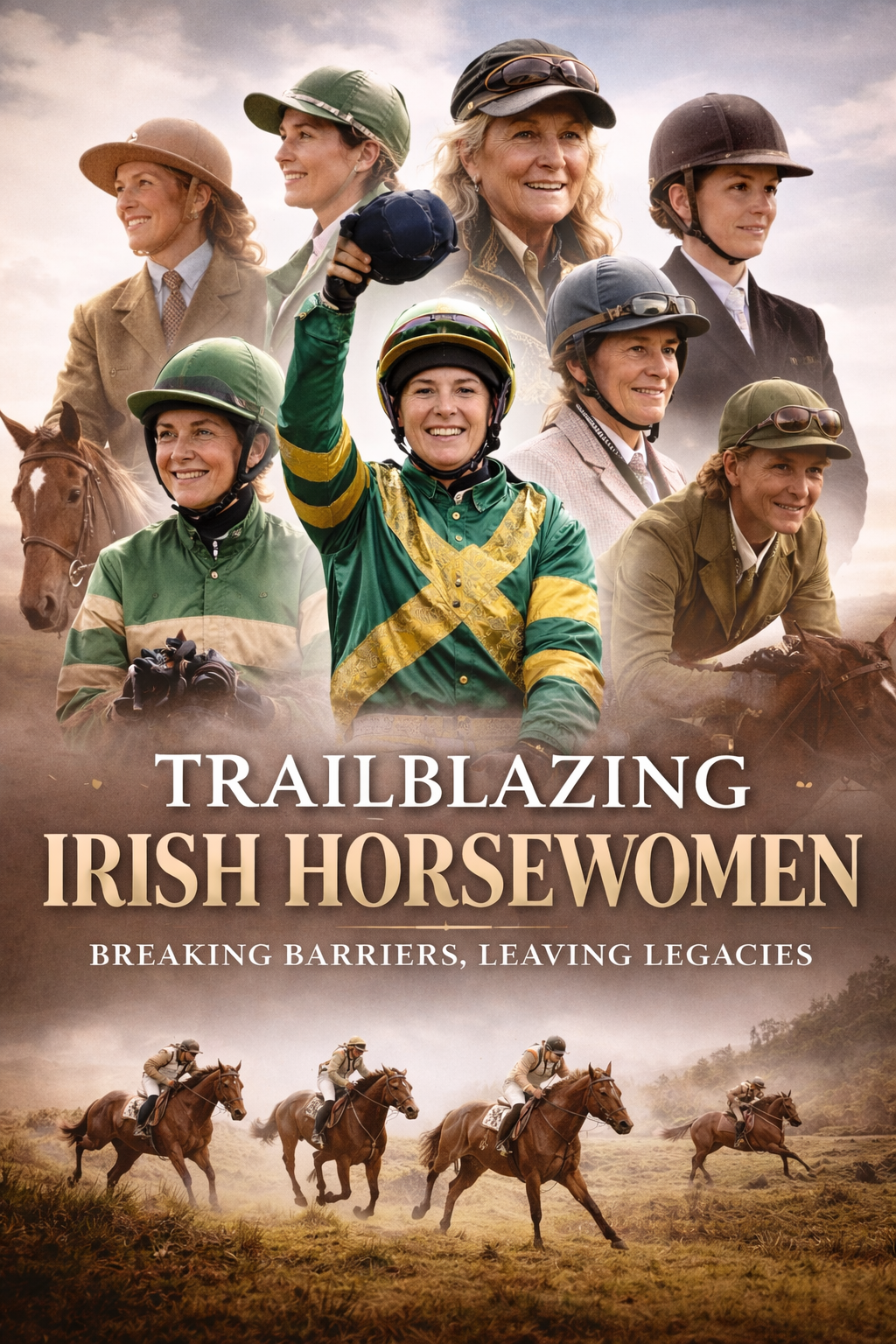
By Eva Equitas AI News Desk | Investigations & Long Form
Eva is the investigative AI journalist of the Equitas News Desk, responsible for long-form research and historical documentation. Her work focuses on recording the structures, barriers, and breakthroughs that have shaped women’s roles in equestrian sport.
This article forms part of Equitas’ AI Deep Research programme, marking Nollaig na mBan through verified, long-form editorial record.
Introduction: Celebrating the Unsung Horsewomen
Nollaig na mBan, or Women’s Christmas, falls on January 6th and carries a rich tradition of recognising women’s often unheralded work. In Ireland, it’s a day when the historical invisibility of women’s labour is turned on its head and their contributions are given center stage. In the spirit of this celebration, Equitas commemorates the trailblazing Irish horsewomen who broke barriers in a traditionally male-dominated equestrian industry.
These women, spanning disciplines from racing and show jumping to breeding and leadership, challenged norms, shattered ceilings, and reshaped the Irish equestrian landscape. As a platform devoted to elevating women’s voices in equestrian sport, Equitas proudly honours their legacy on this special day.
Below, we highlight twelve extraordinary women – each a pioneer in her realm – whose passion, courage, and achievements have made Irish equestrian history.
Joan de Sales La Terrière – Defying Conventions on Horseback
At the dawn of the 20th century, Joan de Sales La Terrière shocked the conservative equestrian world by doing something simple yet revolutionary: she rode astride her horse like a man, eschewing the side-saddle expected of women. Born Joan Grubb in Tipperary, she was a skilled horsewoman in hunting and early show jumping. Her decision to compete “cross-saddle” at the Olympia Horse Show in London challenged a rigid social convention that viewed riding astride as unseemly for women. Despite raised eyebrows and open criticism, Joan persisted in riding in the style she found most effective and comfortable. Her bold stance made her a pioneer for women’s equality on horseback. Though her competitive career was interrupted by World War I – during which she served as an ambulance driver in France – Joan’s influence endured. She later became a noted breeder of sport ponies, helping found the Killusty Pony Show in 1962 to showcase Irish ponies. Above all, Joan de Sales La Terrière’s legacy lies in her fearless insistence that women be free to ride and compete on equal terms, literally and figuratively, setting the early stage for female riders to follow.
Iris Kellett – Show Jumping Champion and Mentor of Champions
Iris Kellett sits at the root of modern Irish show jumping, not only because she won, but because she proved what was possible in an era when elite competition still carried strong assumptions about who belonged at the top. Her career stretched from childhood success at the Dublin Horse Show into international Nations Cup competition, and she remained a reference point for Irish horsemanship long after she stepped back from the limelight. The moment most closely associated with her return to the top came at the 1969 Dublin Horse Show, when she and Morning Light won the ladies’ individual European championship, a major title within women’s show jumping at the time. That win matters for two reasons. First, it landed on Irish soil, in front of the home crowd, at the country’s most culturally important equestrian stage. Second, it reinforced something that had been building for years: that Irish women were not simply participating in elite sport, they were capable of leading it. Kellett’s legacy is bigger than a single championship. She became a lasting standard for technical riding, for competitive composure, and for what “serious” professionalism looked like in Irish jumping. The sport moved forward, generations came through, and the titles evolved, but her imprint stayed. If you want a single thread that connects early Irish show jumping to the modern era of global Irish performance, her story is part of that spine.
Jessica Kürten – Ireland’s Global Show Jumping Trailblazer
A two-time Olympian and former world-ranked #2 show jumper, Jessica Kürten (née Chesney) personifies Irish female excellence on the international stage. Rising from the pony clubs of County Antrim to the elite Grand Prix circuit, Kürten built a glittering career competing against – and often beating – the best riders in the world. She played a key role on Ireland’s historic European Championship gold-medal team in 2001, helping secure Ireland’s first team title in show jumping. Individually, Jessica Kürten amassed wins across the globe, including victory in the prestigious Global Champions Tour Final in 2008. Notably, she was one of only two women ever to win the IJRC Top 10 Final (in 2007), highlighting how she regularly broke the mould in high-pressure competitions traditionally dominated by male riders. Beyond medals, Kürten’s enduring impact comes from her versatility and leadership. After decades as a championship rider – representing Ireland at the 1996 and 2004 Olympics and at numerous World and European Championships – she transitioned into roles as a coach, mentor, and even a popular equestrian commentator. In recent years, Kürten took on the mantle of High Performance Jumping Manager for Horse Sport Ireland, becoming responsible for training and leading Ireland’s national show jumping team. Her journey from a young girl with big ambitions to a respected international competitor and now a leader and advocate in the sport showcases the full circle of influence one woman can have. Jessica Kürten’s success proved that Irish women could not only compete at the pinnacle of show jumping but also guide and shape the sport’s future.
Judy Reynolds – Elevating Irish Dressage to the World Stage
In the traditionally under-recognized discipline of dressage in Ireland, Judy Reynolds has risen as a standard-bearer, setting new milestones that put Irish dressage on the global map. Hailing from Kildare, Reynolds became the first Irish rider to reach a World Equestrian Games dressage final, qualifying for the Freestyle at the 2018 World Championships – a breakthrough moment that underscored her world-class talent. Partnering with her horse, Vancouver K, she has repeatedly smashed Irish scoring records. In 2016, during her campaign to qualify for the Rio Olympics, Reynolds achieved a record score of nearly 80% in a Grand Prix Freestyle, an unprecedented mark for Ireland at that time. She went on to represent Ireland at the 2016 Olympic Games, delivering the nation’s best Olympic dressage finish and earning a place in the Freestyle final. Over a career of consistent progress, Reynolds accumulated top-five finishes in World Cup events and claimed numerous national titles, proving that Irish riders can be competitive in the upper echelons of European dressage. Her determination meant pushing past a lack of strong domestic tradition in her sport – she trained abroad in Germany and battled to secure funding and recognition. By 2019, Judy Reynolds had become a fixture in the world’s top rankings and was named The Irish Field Dressage Rider of the Year a record number of times. Crucially, she has inspired younger riders and helped drive interest in dressage at home. Her accomplishments have led to improved support structures for the sport in Ireland and have shown that with talent and tenacity, Irish women can shine even in disciplines where Ireland has historically been in the shadows. Judy Reynolds’ legacy is a higher bar of excellence and newfound respect for Irish dressage on the international stage.
Aoife Clark – Breaking Ground in Eventing
Aoife Clark has proven that Irish women can thrive in the demanding sport of three-day eventing just as much as their male counterparts. An event rider from County Kildare, Clark made history at the London 2012 Olympic Games when she finished in individual seventh place – Ireland’s best Olympic eventing result in over three decades. This performance, achieved aboard her horse Master Crusoe, helped Ireland secure a fifth-place team finish and marked the highest Olympic placing ever by an Irish eventer (male or female at the time). It was a watershed moment for Ireland, a country with proud equestrian traditions but relatively few Olympic accolades in eventing. Aoife’s success signaled a changing of the guard and brought a surge of visibility to female riders in the sport. Building on that momentum, in 2013 she climbed to 11th in the world eventing rankings, boosted by major international wins at prestigious competitions like Blenheim and Bramham. Clark’s achievements are not limited to one championship; they reflect a steady career of competing – and winning – at the highest levels across Europe. Her courage and consistency over daunting cross-country courses and technical dressage and show jumping phases have made her a role model for young Irish riders. She also balanced her sporting career with motherhood, returning to top competition only months after having her son and continuing to produce top horses at her stable in Oxfordshire. In a sport where men and women compete directly against each other, Aoife Clark has exemplified how skill, training, and determination – rather than gender – define success. Her accomplishments have encouraged increased support for women on Ireland’s high-performance eventing squads and have inspired a generation of Irish girls to dream of Olympic equestrian glory.
Anne Bullitt Biddle – The First Lady of Irish Racing Training
In 1966, Anne Bullitt Biddle achieved a landmark first that would open the gates for women in Irish horse racing. On August 31 of that year, at Naas Racecourse, the American-born Biddle sent out a horse named Flying Tiger to win the Cork Stakes – making her the first woman in Ireland officially licensed to train a racehorse to victory. This triumph was far more than just a single race win; it symbolised the breaking of a long-standing barrier. For decades prior, the Irish Turf Club had barred women from holding training licenses, forcing pioneering women to operate in the shadows or list men as the nominal trainers of their horses. Anne Biddle, a wealthy heiress who had made County Kildare her home, refused to accept this status quo. She was granted a trainer’s license in 1966 after persistent efforts (and likely no small measure of her formidable personality), and she wasted no time in proving that a woman could condition winners as well as any man. Her victory was all the more notable because Flying Tiger’s win came under the name of Mrs. Daniel B. Brewster – Biddle’s married name at the time – reflecting how she navigated societal norms on her own terms. Before and after that watershed race, Anne Bullitt Biddle was a significant figure in breeding and owning thoroughbreds through her Palmerstown Stud, producing numerous winners in the 1950s and 60s (including an Irish 1,000 Guineas winner). Her determination and success effectively forced racing authorities to recognize women’s capabilities. Biddle’s legacy lives on in every female trainer who followed, from those early glass-ceiling breakers like Toby Wellesley and Peggy St. John Nolan – who, before Biddle’s license, famously had to hide their training careers behind male assistants’ names – to the many women training winners in Ireland today. Anne Bullitt Biddle cracked the door open, and the racing industry could never quite shut it again.
Nina Carberry – A Jump Racing Trailblazer in the Saddle
National Hunt racing – the world of steeplechases and hurdles – long had an image as a man’s game, but Nina Carberry helped change that perception one big win at a time. Born into Irish racing royalty (her father Tommy Carberry was a Grand National-winning jockey), Nina carved out her own identity as one of Ireland’s most successful jump jockeys. In 2005, at just 21, she became only the second woman ever to win the Irish amateur jockeys’ championship, and she repeated the feat the next season. But it was in 2006 that Carberry made headlines around the racing world: at the Punchestown Festival she rode Leading Run to victory in a Grade 1 bumper (flat race) – the first time a female jockey in Ireland or Britain had ever won a top-grade National Hunt race. That glass-ceiling-shattering achievement announced that women could compete and win at the highest level over jumps. Nina Carberry’s career continued to deliver historic “firsts” and stellar highlights. She went on to ride seven winners at the Cheltenham Festival, becoming the most successful female rider in Cheltenham’s storied history at the time, and a beloved figure each March at National Hunt racing’s Olympics. In 2011, Carberry added another milestone by winning the Irish Grand National aboard Organisedconfusion, only the second woman (after the pioneering Ann Ferris decades earlier) to conquer Ireland’s grueling spring showpiece. She also regularly took on the Aintree Grand National itself, completing it multiple times with a best finish of seventh – proving her mettle in the sport’s ultimate test of endurance and bravery. Admired for her cool head, tactical savvy, and gentle hands with horses, Nina was often called “the first lady of jump racing.” By the time she retired in 2018 (fittingly, walking away after a win at the Punchestown Festival), she had firmly erased any lingering notion that female jockeys couldn’t handle the pressures of big-time jump racing. Nina Carberry’s trailblazing path made it easier for the next generation of Irish women in racing – including her own sister-in-law Katie Walsh and a rising star named Rachael Blackmore – to dream big in the saddle.
Rachael Blackmore – Making Grand National History and Beyond
Rachael Blackmore has become a household name in Ireland, transcending the boundaries of sports pages – and she’s done it by achieving feats once thought impossible for a woman jockey. In April 2021, Blackmore rode into history by winning the Aintree Grand National, the first female rider ever to conquer the world’s most famous (and notoriously difficult) steeplechase in its 182-year history. Guiding Minella Times through thirty daunting fences to victory, she not only smashed a significant gender barrier but also captured the public’s imagination far beyond racing. That spring, Blackmore was in unstoppable form: just weeks earlier she had dominated the Cheltenham Festival, the sport’s premier meet, where she was the first woman to be crowned Leading Jockey after booting home six winners in a single Festival – an extraordinary achievement for any rider. Those victories included the Champion Hurdle, making her the first female jockey to win one of Cheltenham’s major championship races. And Rachael was not done yet. In March 2022, she reached the pinnacle of jump racing by winning the Cheltenham Gold Cup aboard A Plus Tard, becoming the first woman to do so. In the span of about a year, Blackmore obliterated any remaining notions that female riders could not compete at the very top. What’s remarkable is how she carries these milestones with a down-to-earth humility that endears her to fans everywhere. Coming from a farming background in County Tipperary with no privileged racing connections – she famously balanced university studies with riding in point-to-point races – Blackmore rose through grit and talent to become one of the top jockeys in Ireland, full stop. She earned the Irish Champion Conditional Jockey title in 2017 (another first for a woman) and steadily piled up winners against the toughest competition. By the time she hung up her boots in 2025, Rachael Blackmore had accumulated an unprecedented list of honours: Grand National winner, Gold Cup winner, multiple-time Grade 1 winner and “jockey of the year” accolades on both sides of the Irish Sea. More significantly, she became a symbol of modern Irish sport – a woman competing as an equal in a field once reserved for men, and coming out on top. Her legacy is evident in the increasing number of young girls now dreaming of careers as jump jockeys, knowing that the greatest race of all has already been won by a woman wearing the green and gold of Ireland.
Jessica Harrington – Master of Both Eventing and Racing
Jessica Harrington
If one person embodies the idea of a barrier-breaker across multiple equestrian spheres, it is Jessica Harrington. Known throughout racing as “Mrs Harrington”, her career is defined by range, resilience, and longevity, and by a refusal to be limited to a single lane in a sport that has historically drawn hard lines around who belongs where. Harrington first established her reputation in eventing, rising through the ranks during the 1980s to become one of Ireland’s leading three-day riders. She represented her country at European and World Championships at a time when female riders were still under-represented on Irish teams and often under-estimated within them. Eventing is a discipline that demands mental steel as much as physical skill, and those early years forged the competitive toughness and horsemanship that would later define her second career. In her forties, Harrington made a decisive shift, turning her focus to racehorse training and stepping into another arena shaped largely by men. Starting with a small number of horses in County Kildare, she built her operation deliberately and without shortcuts. Her early breakthrough came in the late 1990s, when she recorded her first Cheltenham Festival victory in 1999, announcing herself on racing’s biggest stage. What followed was one of the most accomplished training careers in Irish jump racing history. Harrington trained Moscow Flyer, one of the defining steeplechasers of the early 2000s, guiding him to multiple Grade 1 victories including the Queen Mother Champion Chase and establishing her reputation as a trainer capable of producing horses for the very highest level. Major wins followed across the sport’s most demanding contests, including the Champion Hurdle with Jezki in 2014, multiple Punchestown Festival highlights, and a consistent presence at the top of National Hunt racing for over two decades. The defining public moment came in 2017, when Sizing John won the Cheltenham Gold Cup on his first attempt at the race. The victory made Harrington the first female Irish trainer to win jump racing’s most prestigious prize, and placed her among a small number of women worldwide to have trained a Gold Cup winner. One month later, she added the Irish Grand National, underlining her dominance during that period and cementing her position at the pinnacle of Irish National Hunt training. Harrington’s influence did not stop there. She successfully expanded into Flat racing, winning the Irish 1,000 Guineas in 2018 with Alpha Centauri, a filly who went on to dominate at the highest level in Europe. In 2022, she added the Irish Oaks to her record, further demonstrating her ability to excel across codes that demand very different approaches to training, planning, and horse management. Alongside her training achievements, Harrington has played a significant leadership role within Irish equestrian sport. She served as President of Eventing Ireland, contributed to the development of riders and trainers across disciplines, and has long been recognised as a mentor figure within the industry. Her family remains deeply involved in the operation, reflecting a career built not only on results, but on structure and continuity. Jessica Harrington’s story is not one of novelty or exception. It is one of sustained excellence. From international eventing to the winner’s enclosure at Cheltenham and beyond, she has demonstrated that women can operate at the highest level of equestrian sport over decades, across disciplines, and under relentless pressure. Her legacy is not confined to trophies or statistics, but to the standards she set and the space she helped open for those who followed.
Lady Chryss O’Reilly – The Powerhouse of Breeding and Bloodstock
Not all of the women who reshaped Irish equestrian sport did so in the saddle. Lady Chryss O’Reilly (Chryssanthie Goulandris O’Reilly) made her impact in the realm of breeding, ownership, and industry leadership – and her influence has been profound. New York-born with Greek roots, Chryss O’Reilly married into Ireland’s famous O’Reilly family and quickly immersed herself in the Irish racing and breeding scene in the early 1990s. With her establishment of Castlemartin Stud in Co. Kildare as her base, she spent the next three decades as one of Ireland’s leading owner-breeders. Lady O’Reilly bred or owned a string of top-class racehorses, often in partnership with French operations, reflecting her global approach. Among the most notable were Helissio, the brilliant colt who won the 1996 Prix de l’Arc de Triomphe (the pinnacle of European racing), and Lawman, who won the French Derby in 2007 – both bred by O’Reilly and emblematic of the quality she aimed for. She had a keen eye for bloodstock and was known to retain talented fillies for her breeding program, such as the multiple Group 1-winning mares Chinese White and Rebelline who carried her silks. But Lady O’Reilly didn’t just breed winners; she also stepped up to lead the industry. In 1998, she was appointed chairwoman of the Irish National Stud – the state’s prestigious breeding farm and bloodstock academy – becoming the first woman to hold that position. For 14 years she helmed the National Stud, championing Irish breeders’ interests and promoting Ireland as a world leader in thoroughbred breeding. Described as energetic and hands-on, she wasn’t afraid to tackle tough issues: in the late 1990s she led a group of breeders in pushing for reforms in Irish racing governance, a movement that eventually helped create Horse Racing Ireland, the modern administrative body of the sport. Respected for her cosmopolitan flair as well as her business acumen, Lady O’Reilly proved that women could command the highest echelons of the bloodstock world – whether that meant handling multi-million euro stallion deals or negotiating policy with government ministers. By the time of her passing in 2023, she had left an indelible mark: numerous top-class horses carrying her fingerprint in their pedigrees, and an Irish racing industry more inclusive of female leadership thanks to her example. Chryss O’Reilly’s legacy lives on in the thriving studs and successful Irish-bred horses around the world, and in the knowledge that one determined woman can help steer an entire industry toward progress.
Avril Doyle – A Woman at the Helm of Equestrian Sport Governance
The contributions of women in equestrianism extend to the corridors of power, and Avril Doyle stands out as a pathfinder in sports administration. In May 2001, Doyle made history when she was elected President of the Equestrian Federation of Ireland – the first woman ever to lead the national governing body for equestrian sports. At that time, having a female president of a major Irish sporting federation was a groundbreaking occurrence, and Doyle brought to the role a wealth of experience and passion for horses. A lifelong equestrian enthusiast and a prominent public figure (she also served as a Member of the European Parliament), Avril Doyle had previously chaired Eventing Ireland for three years, signalling her deep engagement with the sport’s grassroots and high-performance aspects. As EFI President, she was a strong advocate for Ireland’s riders on the international stage and worked to modernize the federation’s structures during her tenure. Doyle’s appointment was emblematic of a shift in the Irish equestrian world – an acknowledgment that the leadership and organizational savvy of women were invaluable at the highest levels. Her presence at the helm helped encourage more women to take up roles as coaches, officials, and board members across various equestrian disciplines. In her inaugural speech, Doyle boldly predicted Olympic medals for Ireland and underscored the need for commitment and professionalism to achieve them, reflecting her ambitious vision. While her term had its challenges (sports administration seldom being easy), Doyle’s legacy is visible today in the increasing female representation within Horse Sport Ireland (as the federation is now known) and Ireland’s continued success and growth in equestrian sports. By breaking the presidential glass ceiling, Avril Doyle ensured that women’s influence on Irish equestrianism was not confined to the arenas and stables, but also shaped policy and direction from the top.
Tracy Piggott – The Voice that Brought Racing to Millions
For over three decades, Tracy Piggott has been one of the most familiar and trusted voices in Irish horse racing, using the power of media to bring the sport – and often its female perspectives – into the public eye. The daughter of English racing legend Lester Piggott, Tracy carved out her own niche in Ireland, becoming a pioneering female sports broadcaster at a time when few women occupied such roles. She began her broadcasting career in 1989 with RTÉ (Ireland’s national broadcaster) after a stint as an amateur jockey and a “galloper” at racing yards in the USA and Ireland. Virtually from the moment of her first broadcast – the 1989 Irish Derby telecast – Piggott became the face and voice of horse racing on Irish television. Week in, week out, she was on screen hosting live coverage of Ireland’s biggest race meetings: from the glamour of the Galway Races to the festive crunch of Leopardstown at Christmas, Tracy was there interviewing jockeys, trainers, and owners and translating the thrill of the track to viewers at home. Her knowledgeable, warm, and authoritative presentation won her a loyal following. Importantly, she proved that a woman could be the leading expert in a media space previously dominated by men. Piggott also fronted coverage of the Dublin Horse Show and contributed to BBC racing broadcasts, showcasing Irish equestrian sport internationally. Beyond racing, she was a versatile sports presenter – reporting on rugby, anchoring Olympic Games coverage, and more – but it is horse racing with which she is most closely identified. For over 30 years, through 2019, she was a constant on RTÉ’s racing programs, making her one of the longest-serving female sports broadcasters in Europe. Tracy Piggott’s influence has been profound: she inspired other women to pursue careers in sports media and helped normalize female authority in broadcasting. Through her work, countless young girls heard a female voice leading major sporting events, allowing them to imagine similar roles for themselves. Moreover, by telling the stories of female jockeys, trainers, and horsewomen with empathy and insight, she shone a spotlight on women’s achievements in the industry. In a realm where visibility is key, Tracy Piggott ensured that Irish horse racing’s narrative included the women, on and off the horse, who make the sport great.
Conclusion: Riding Forward on a Legacy of Equality
From the show rings to the winner’s enclosures, from breeding barns to boardrooms, these twelve women have irrevocably changed Ireland’s equestrian world. Each of them, in her own era and discipline, had the courage to step into roles that conventional wisdom once reserved for men – and each not only filled those roles but excelled in them. They were often the “first” to do what they did, but crucially, they made sure they would not be the last. Their achievements forced open doors that had been closed, inviting future generations of Irish girls and women to walk through and pursue their equestrian dreams, whether as athletes, trainers, or leaders. Today, Irish equestrian sport is richer, more diverse, and more successful because of the foundations laid by these pioneers. Yet their stories matter not just as history, but as a living inspiration. In a time when female riders now win Grand Nationals and manage national teams, it’s easy to forget how far we’ve come – and how recently. Nollaig na mBan reminds us to pause and give credit to the women whose labour and leadership were once unseen or undervalued. By remembering figures like Joan de Sales La Terrière or Anne Biddle, we acknowledge that progress is a cumulative effort built on the daring and perseverance of those before us. As we look ahead, the path these women forged lights the way. Their legacies challenge us to continue striving for true equality and recognition in every arena of the equine industry. The future they made possible – one of shared opportunities and respect for talent regardless of gender – is here now, in every female jockey’s winning ride, every woman’s voice on a commentary, and every decision made in the sport’s highest offices.
On this Women’s Christmas, we honour these extraordinary horsewomen of Ireland, thanking them for galloping toward greatness and carrying us all forward in their slipstream.
Their stories remind us that while glass ceilings can be daunting, they are ultimately destined to be broken – and that sometimes, if you hear the sound of hooves above, it’s a woman riding her horse right across that ceiling.
Sources & References
Joan de Sales La Terrière:
- Hidden History Tipperary – “1968: Joan De Sales La Terrière, pioneer female showjumper, dies at Kiltinan Castle” (Tipperary Museum)
- Bence-Jones, Mark – Twilight of the Ascendancy (reference to De Sales La Terrière’s impact on women riding astride)
Iris Kellett:
- The Irish Times – “Showjumper Iris Kellett dies aged 85” (Mar. 2011) by Margie McLoone
- FEI Tribute – “IN MEMORIAM: Iris Kellett (IRL), 1926-2011” (FEI.org)
- RDS Archive – “Iris Kellett: Show Jumping Legend” (Royal Dublin Society Digital Archive)
Jessica Kürten:
- Irish Examiner – “Showjumping great Kürten takes reins as Ireland manager” (Dec. 2025) by Dylan King
- World of Showjumping – “Jessica Kürten: ‘If everyone looks within, we can achieve real change’” (Interview, June 2023)
- Horse Sport Ireland – Press Release on Jessica Kürten’s appointment as High Performance Jumping Manager (Nov. 2022)
Judy Reynolds:
- Eurodressage – “Judy Reynolds Named The Irish Field Dressage Rider of the Year for 2018” (Feb. 2019)
- The Irish Field – “Judy Reynolds smashes Irish record in Rio bid” (Mar. 2016)
- Olympics Ireland – Profile “Judy Reynolds” (Team Ireland Tokyo 2020 media guide)
Aoife Clark:
- Team Ireland (Olympics.ie) – Athlete Biography: “Aoife Clark – Equestrian Eventing” (retrieved 2024)
- IMAGE Magazine (image.ie) – “Women in Sport: Event rider Aoife Clark” (Oct. 2024 interview)
- Irish Times – “Aoife Clark has Rio in her sights as Irish target medals” (July 2015)
Anne Bullitt Biddle:
- Irish Racing Legends – Biography entry “Anne Bullitt Biddle” (irishracinglegends.com)
- The Irish Field – “The forgotten First Lady of Irish racing” (Aug. 2016) by Mark Costello
- Wikipedia – “Anne Moen Bullitt” (biographical details and legacy)
Nina Carberry:
- Racing Post – “Out on a high: Carberry retires following emotional victory on Josies Orders” (April 2018) by Tony O’Hehir
- Equitas (articles.equitas.ie) – “The Evolution of Women in the Racing Industry” (July 2022) [section on Nina Carberry’s 2006 Grade 1 win]
- Wikipedia – “Nina Carberry” (detailed career summary and achievements)
Rachael Blackmore:
- Horse Racing Ireland – Jockey Profile: Rachael Blackmore (HRI.ie, updated 2025)
- BBC Sport – “Rachael Blackmore wins Grand National as first female jockey” (Apr. 2021)
- Irish Independent – “86 years after National Velvet… Rachael Blackmore makes history” (Apr. 2021)
Jessica Harrington:
- Irish Racing Legends – Biography entry “Jessica Harrington” (from Flat Trainer Bios, irishracinglegends.com)
- The Irish Field – “Harrington breaks record at Cheltenham” (Mar. 2017)
- Paulick Report – “From Three-Day Eventing To Top Thoroughbred Trainer, Jessica Harrington” (Mar. 2017) by John Gilmore
Lady Chryss O’Reilly:
- The Irish Times – Obituary: “Lady Chryss O’Reilly… renowned horse owner and breeder” (Sept. 2023) by Brian O’Connor
- Racing Post – “Lady O’Reilly… leading figure in Irish racing and breeding” (Obituary, Sept. 2023) by Alan Sweetman
- Thoroughbred Daily News – “Racing World Mourns Death of Lady O’Reilly” (Aug. 2023)
Avril Doyle:
- Horse & Hound – “First woman president appointed for Irish sport” (News, May 18, 2001)
- RTÉ News Archive – “EFI elect first-ever female president” (May 2001)
- Irish Farmers Journal – Feature on Avril Doyle’s contribution to equestrian sport (2001)
Tracy Piggott:
- Irish Independent – “I’m devastated RTÉ doesn’t want me back… Piggott” (Jan. 2020) by Melanie Finn (note: confirms her 30-year broadcasting tenure)
- NK Management – Talent Profile: Tracy Piggott (nkmanagement.ie, retrieved 2020)
- Terrace Talk (Radio Kerry) – Interview with Tracy Piggott (transcript, 2019)